By Dr Amer Mujkanovic, Co-founder and NHS GP · 19 October 2026 · 5 min read
Svetlana Mojsov, Jens Juul Holst and the discovery of GLP‑1
How chemist Svetlana Mojsov and physician Jens Juul Holst identified the active form of GLP-1 in 1987, laying foundations for today's medicines.
How a peptide chemist from Skopje, a Danish physician and an international community of scientists helped lay the foundations for today's diabetes and weight-management medicines.
Behind medicines such as Ozempic, Wegovy and Mounjaro lies a scientific story spanning decades of hard work, dedication and, at times, disputed credit. It involves painstaking chemistry, experiments exploring how the gut communicates with the pancreas, and the challenge of turning a short-lived hormone into a practical treatment.
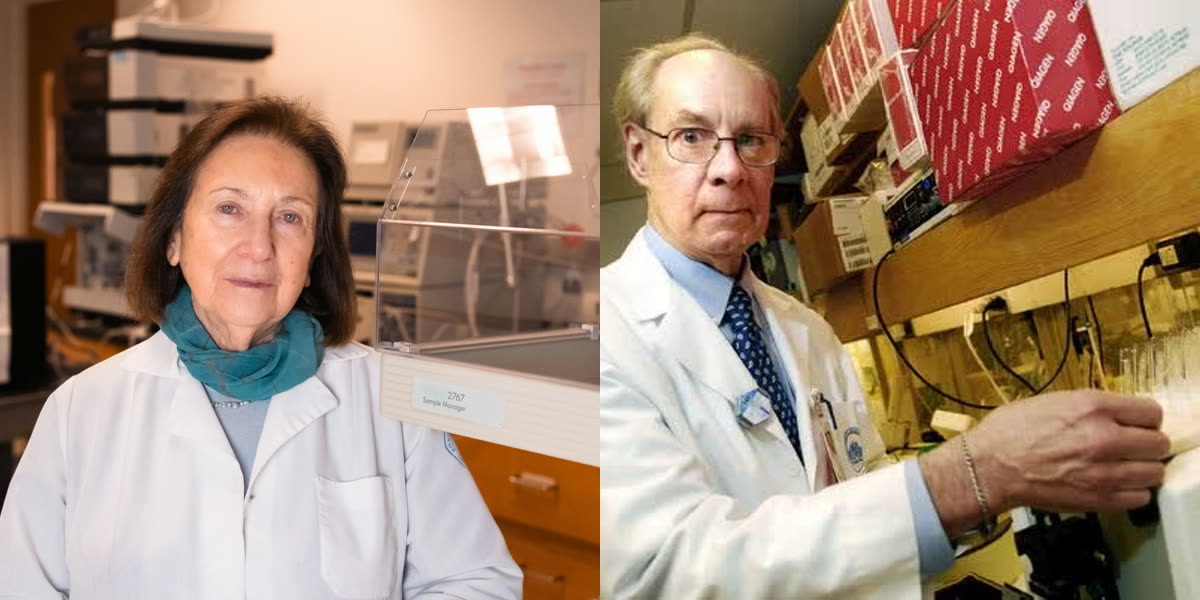
Two central figures were Svetlana Mojsov and Jens Juul Holst. Working on opposite sides of the Atlantic, they helped establish the identity and biological activity of [GLP-1 (glucagon-like peptide-1)](/guides/what-is-glp-1). Their discoveries were part of a wider effort involving laboratory researchers, clinicians and drug-development teams.
From Skopje to Rockefeller and Massachusetts
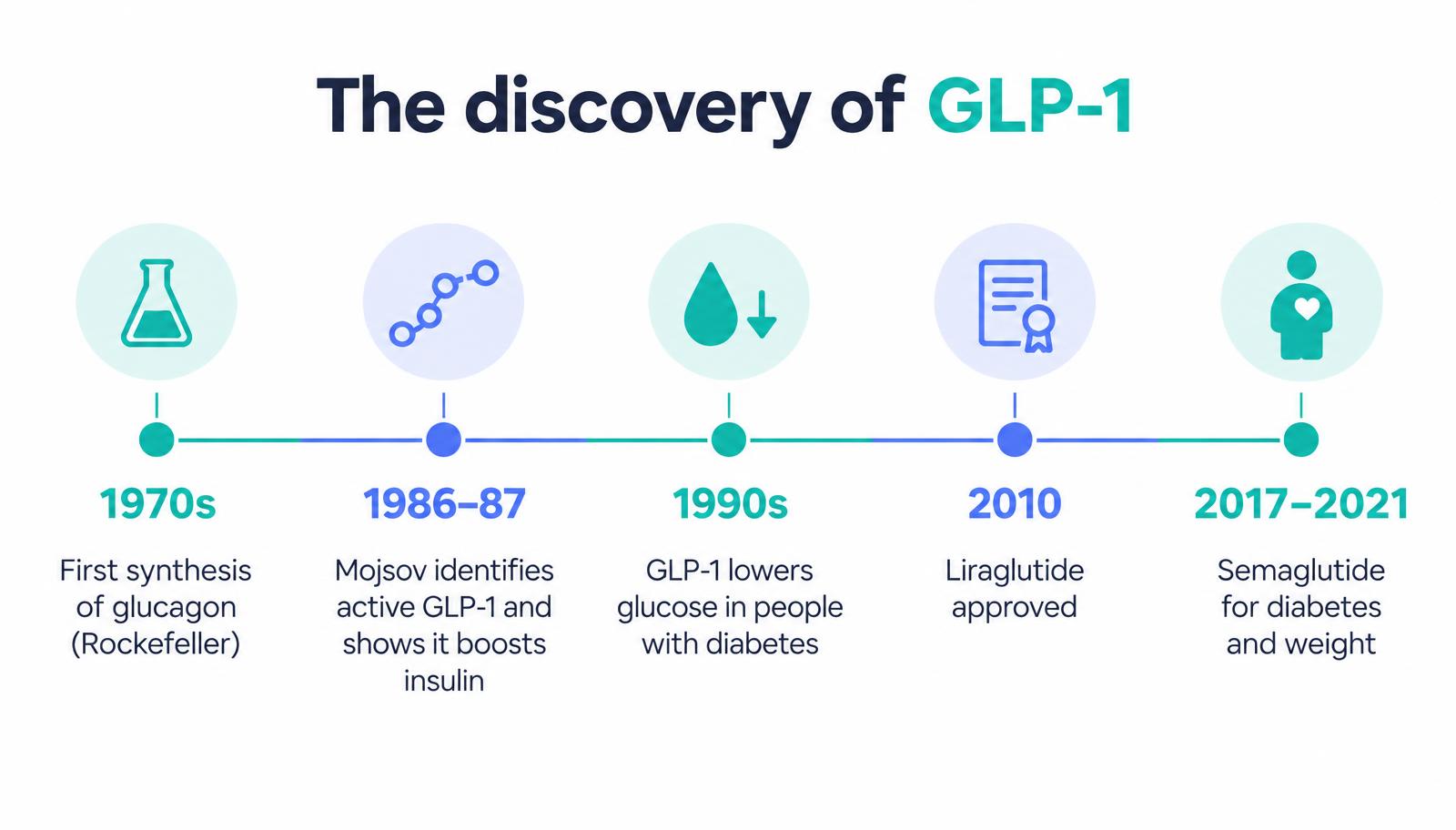
Svetlana Mojsov was born in Skopje, in what is now North Macedonia. In the early 1970s she joined Bruce Merrifield's laboratory at Rockefeller University in New York as a PhD student. Merrifield, who later received the Nobel Prize in Chemistry, had pioneered a method of building [peptides](/guides/glp-1-vs-peptides) one amino acid at a time.
Her early research focused on glucagon, a hormone with a central role in how the body regulates blood glucose.
At the time, scientists were trying to explain a striking observation. Glucose taken by mouth triggers more insulin release than glucose given into a vein, even when blood glucose levels are matched. This is called the incretin effect. It showed that the gut sends extra signals to the pancreas after we eat, but those signals had not been fully identified.
In 1983 Mojsov moved to Massachusetts General Hospital to lead its peptide synthesis facility. There, she applied her chemistry expertise to identifying the active form of GLP-1, one of the gut hormones responsible for this effect.
A puzzle hidden inside a hormone precursor
Research involving Joel Habener and colleagues had revealed that glucagon was part of a larger precursor protein. That precursor also contained the sequences of additional glucagon-like peptides.
But identifying a sequence was only the beginning. Researchers still needed to establish which forms the body actually produced, and what they did.
Mojsov identified and synthesised a shortened form of GLP-1 that proved biologically active. Working with Gordon Weir and Joel Habener, she showed that it strongly stimulated insulin release from an isolated rat pancreas. Their findings were published in 1987.
Recognition, decades later
For many years Mojsov's role was overlooked, and her contributions were not adequately recognised by Massachusetts General Hospital. After a prolonged legal process, she secured recognition as a co-inventor on key patents.
Wider scientific recognition followed decades later. She has since received awards including the Lasker Award and the Breakthrough Prize in Life Sciences, and was included in the TIME100 list. In 2026 Rockefeller University promoted her to Research Professor.
Jens Juul Holst: the parallel discovery in Denmark
Meanwhile, at the University of Copenhagen, physician and physiologist Jens Juul Holst was investigating how hormones from the gut influence insulin secretion.
His group approached the problem by studying the hormone present in intestinal tissue. In a landmark 1987 paper, Holst and colleagues reported isolating a shortened GLP-1 peptide from pig intestine. They showed that it powerfully stimulated insulin release from an isolated pig pancreas.
The American and Danish findings converged on the same essential insight: the active hormone was a shortened version of the initially predicted GLP-1 sequence.
Holst's team also helped establish GLP-1's wider effects in the body, including suppressing glucagon release and influencing gut function. These findings helped explain why the hormone might be useful in treating diabetes and obesity.
From laboratory experiments to people
Several groups then investigated whether these effects translated to humans.
David Nathan, Mojsov, Habener and colleagues published an early clinical study in 1992 examining GLP-1 in people with and without diabetes. Their work provided evidence of its potential to improve glucose regulation.
In 1993 Michael Nauck, Holst, Ørskov, Werner Creutzfeldt and colleagues reported another important result: an intravenous GLP-1 infusion brought fasting glucose into the normal range within four hours in a small study of ten people with poorly controlled type 2 diabetes.
This was compelling proof of therapeutic potential, although it was still far from a treatment people could use at home. Natural GLP-1 is broken down within minutes, and it took many more years of work to develop longer-acting versions.
What this means if you take one of these medicines
These treatments act on signalling systems your body already uses to regulate blood glucose and appetite. Their effects can include stimulating insulin release when glucose is raised, reducing appetite and slowing stomach emptying. Tirzepatide also acts on a second gut hormone pathway, GIP.
The injection pen is the visible result of decades of research: identifying the right molecule, understanding its effects, testing it in people and making its action last.
Benefits and risks
GLP-1 medicines can help some adults with type 2 diabetes or obesity, but they are not suitable for everyone. Side effects are common, especially nausea, vomiting, diarrhoea and constipation. Less common but serious risks include pancreatitis and gallbladder problems, and these medicines should not be used in pregnancy.
Whether a medicine is right for you is a decision for you and your GP or a registered prescriber, who can review your full medical history. Only obtain medicines from a regulated prescriber and pharmacy: products sold online without a prescription may be fake or contaminated. If you have severe abdominal pain, contact NHS 111, or call 999 in an emergency.
Sources
- Rockefeller University news, "Svetlana Mojsov promoted to Research Professor" (2026): rockefeller.edu
- The New York Times, "Joel Habener, whose research led to GLP-1 drugs, dies at 88" (9 January 2026): [nytimes.com](https://www.nytimes.com/2026/01/09/health/joel-habener-dead.html)
- Mojsov S, Weir GC, Habener JF. Insulinotropin: glucagon-like peptide I (7-37) co-encoded in the glucagon gene is a potent stimulator of insulin release in the perfused rat pancreas. Journal of Clinical Investigation, 1987.
- Holst JJ, Ørskov C, Nielsen OV, Schwartz TW. Truncated glucagon-like peptide I, an insulin-releasing hormone from the distal gut. FEBS Letters, 1987.
- Nauck MA, Kleine N, Ørskov C, Holst JJ, Willms B, Creutzfeldt W. Normalization of fasting hyperglycaemia by exogenous glucagon-like peptide 1 (7-36 amide) in type 2 (non-insulin-dependent) diabetic patients. Diabetologia, 1993.
- Wikipedia: Svetlana Mojsov; Jens Juul Holst; Joel Habener; and the references cited there.
- NHS.uk: [semaglutide](https://www.nhs.uk/medicines/semaglutide/), [liraglutide](https://www.nhs.uk/medicines/liraglutide/) and [tirzepatide](https://www.nhs.uk/medicines/tirzepatide/) medicine pages. NICE guidance TA875 (semaglutide) and TA1026 (tirzepatide). MHRA: guidance on buying medicines safely online.
Related
Levli is not a medical service and this page is general information, not medical advice. Always consult your healthcare provider about your medication, dose or health. Medication level estimates in Levli are illustrative only.